Scientists identify record-breaking oldest and farthest quasar
A newly discovered quasar named Dun Aonghasa pushes the boundary of the known universe back to 630 million years after the Big Bang, revealing a massive black hole in the early cosmos.
By Riya Davis ·
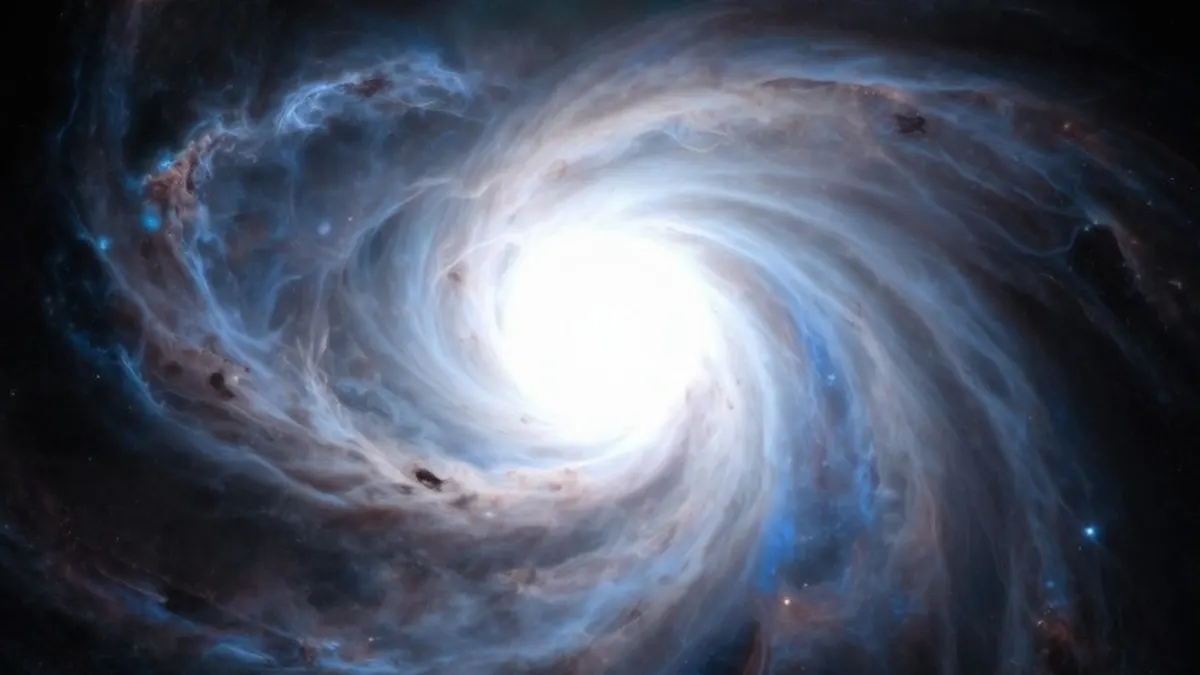
Researchers have identified the most distant quasar ever found, marking a significant milestone in our understanding of the early universe. This celestial object, which hosts a supermassive black hole at its center, formed just 630 million years after the Big Bang. The discovery, reported by a German-led team on Tuesday, breaks previous records and offers a rare glimpse into a period when the cosmos was only a fraction of its current age.
The universe is estimated to be 13.8 billion years old, making this quasar a relic from its infancy. Julien Wolf, who led the study from the European Southern Observatory, noted that this finding represents a substantial leap in cosmic time compared to previous discoveries. He explained that recent records had only extended our knowledge by roughly 15 million years each. In contrast, this new finding pushes the timeline back by nearly 40 million years, the largest advance in the field in almost a decade.
The quasar was detected during a detailed analysis of millions of observations made by the Euclid telescope. Launched in 2023 by the European Space Agency, Euclid is designed to survey galaxies to better understand dark matter and dark energy, the mysterious forces driving the expansion of the universe. While finding any quasar this early is unusual, the specific characteristics of this object make it even more extraordinary.
What distinguishes this particular quasar is the immense mass of its central black hole, despite its relatively slow rate of consumption. Scientists are observing the object as it appeared 13.1 billion years ago, a time when the universe had reached less than 5% of its present age. The combination of its early formation and its massive core challenges existing models of how black holes could grow so large so quickly.
Wolf, whose wife and daughter are Irish, named the quasar Dun Aonghasa after a prehistoric stone fort located on the Aran Islands in Ireland. He described the fort as a frontier holding the promise of a vast horizon yet to be explored, a metaphor that he felt perfectly aligned with the nature of this distant astronomical discovery. The name reflects the sense of awe he experienced when visiting the site with his family.
To verify their initial findings, the team utilized data from multiple sources, including the Hubble and James Webb Space Telescopes, as well as various ground-based and space-based observatories. The James Webb Space Telescope provided critical insights into the mass of the black hole powering the quasar. Data from Webb indicates that the black hole has a mass equivalent to 360 million suns, a staggering figure for an object existing so early in the history of the universe.
The results of this research have been published in the journal Astronomy & Astrophysics. The discovery establishes a new deadline for understanding the early universe. Wolf emphasized the central question that now faces astronomers: how did this black hole manage to grow to such a colossal size within just 630 million years of the Big Bang?
The search for even older and more distant objects continues as scientists keep probing the cosmic dawn. Wolf acknowledged the transient nature of such records, noting that this title could be claimed by another discovery within a few months, or it might stand for several years. Either way, the finding provides a crucial data point for refining our understanding of galactic evolution in the first billion years of the universe.
More News · National news · Report a business · Got a Story?